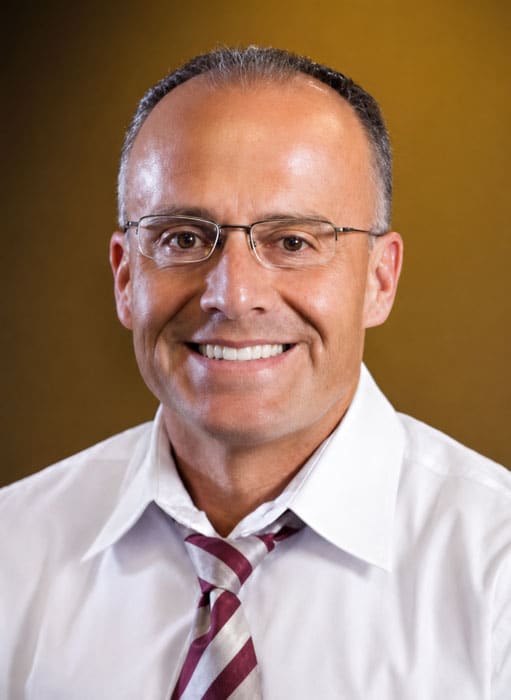
He came out of the University of New Mexico and the UNM School of Law and went to work as an Assistant City Attorney for the City of Albuquerque. He has spent the years since then representing cities, counties, the State, and the officers who work for them. The work is Section 1983 and the New Mexico Tort Claims Act. The facts are almost never gentle. High-speed pursuits. Warrantless arrests. Search-warrant service. Crowd control at mass protests. Tasers. Police dogs. Prison and jail cases. And, more than any other New Mexico lawyer of his generation, police shootings.
Thirteen of those shooting cases have ended in a defense judgment — five by jury verdict, eight by summary judgment. Five K-9 apprehension cases have gone to a jury and come back for the officer. Two of the largest protest cases ever tried in this state — the March 2003 anti-war demonstrations that produced Buck v. City of Albuquerque and Fogarty v. Gallegos — ended in defense verdicts. In Buck, twelve plaintiffs put fifty claims in front of a federal jury. The jury found for the officers on every one of them.
The criminal docket has been as public as the civil one. In 2016 he represented Albuquerque Police Department SWAT Officer Dominique Perez, charged with second-degree murder in the foothills shooting of James Boyd — the first on-duty Albuquerque police murder trial in half a century. After two and a half weeks of evidence, the jury hung nine to three for the officers. The special prosecutor dismissed the charge. The Department of Justice declined to step in.
The same discipline shows up on appeal. He has defended judgments and qualified-immunity orders in police-shooting, wrongful-imprisonment, and K-9 cases in the Tenth Circuit. In Salgado v. Smith, a New Mexico State Police shooting on Interstate 25, he obtained qualified immunity in the district court, held it in the Tenth Circuit, and saw the Supreme Court deny the estate’s petition for certiorari in January 2026. In Garrison v. Polisar, a SWAT shooting of a homeowner who came to the door armed, he obtained summary judgment, an affirmance, and a denial of certiorari in 2001. In James v. Chavez, a SWAT hostage-rescue shooting, the district court granted summary judgment and the Tenth Circuit affirmed. In Padilla v. City of Farmington — the 2023 Farmington case in which officers went to the wrong house on a domestic call and shot Robert Dotson when he opened the door with a handgun — the district court granted qualified immunity in 2025.
The courtroom is only half of the practice. Agencies hire him to write the rules that keep the next case from being filed, and to teach the officers who will have to live inside those rules. He drafted the use-of-force, deadly-force, search-and-seizure, and limited-arrest curriculum for the U.S. Department of Energy’s National Training Academy and taught it. He rewrote Farmington’s standard operating procedures. He rewrote the Metropolitan Detention Center’s operational policies — medical, mental health, classification, grievances, investigations, segregation, use of force — inside the McClendon litigation. He has taught civil rights and lethal-force blocks at the Albuquerque Police Academy. He is a New Mexico Department of Public Safety-certified Professional Lecturer and Master Instructor in warrantless arrest, less-lethal force, deadly force, and civil liability under both Section 1983 and the Tort Claims Act.
That teaching work now runs nationally. Since 2020 he has been on the instructor faculty of the National Tactical Officers Association, teaching at NTOA national and mid-year conferences. His NTOA courses include The Articulation of the Use of Deadly Force, Why Well-Written Police Reports Still Matter in the Age of Body-Worn Camera Videos, and Just Another Witness — Body-Worn Cameras. The same work produced an invitation to teach the Toronto Emergency Task Force. In 2022 the International Association of Chiefs of Police invited him to speak at its annual conference. He sits on the IACP Legal Officers Section and is a member of the National Tactical Officers Association. His articles on body-worn cameras, the ADA and mental illness, and how to explain a use of force to a jury have appeared in The Tactical Edge. His training manual, The Law of Less-Lethal and Deadly Force, is used by departments that have never heard his name.
When New Mexico sued the opioid industry, he was one of the lawyers in the room for the State, sixteen counties, and three cities. After an eight-week bench trial, the governmental clients recovered, in the aggregate, more than one billion dollars.
Martindale-Hubbell has rated him AV Preeminent for more than fifteen years. The New Mexico Board of Legal Specialization has certified him as a specialist in local government law.
He spent years on the sideline and in the boardroom of youth soccer in Albuquerque, coaching his sons’ teams and serving on the board of Rio Soccer Club and as coach administrator for the Duke City Soccer League. What he does now, when he is not in a courtroom or an academy classroom, is hike new and challenging mountain ranges throughout North America, and travel.